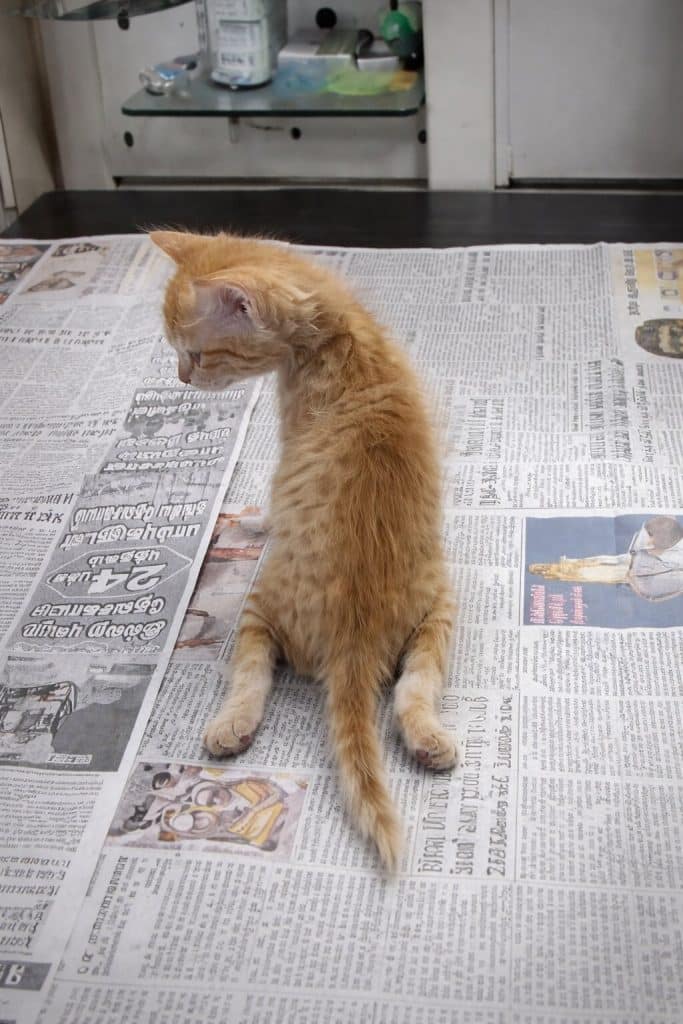
On a table covered with newspaper, a small yellow kitten pulled himself forward using only his front paws.
His back legs trailed behind him.
They didn’t push.
They didn’t lift.
They simply followed, unresponsive, as he dragged the lower half of his body inch by inch.
It would have been easy to assume he would give up.
But he didn’t.
When Movement Doesn’t Happen by Choice
The video gently explains a condition known as loss of voluntary movement.
In simple terms, it means the kitten cannot control certain muscles the way he should. The brain may be sending signals — but somewhere along the pathway between nerves and muscles, those signals are interrupted.
VIDEO: His Brain Says “Move” — But His Back Legs Cannot Listen. Watch How He Keeps Trying Anyway
When that coordination system is affected, several signs can appear:
• Weak or reduced movement
• Muscle fatigue
• Decreased reflexes
• Limited range of motion
• Difficulty performing certain actions
For this kitten, those signs are most visible in his hind legs.
They appear either paralyzed or extremely weak, unable to support his weight.
A Body That Moves in Its Own Way
And yet, the rest of him is alert.
His head lifts quickly when he hears a sound.
His eyes track movement nearby.
His front paws grip the surface with determination.
He adjusts his balance carefully as he pulls himself forward. The newspaper beneath him crinkles softly with each effort.
It isn’t graceful.
But it is determined.
It’s not a dramatic transformation.
It’s a quiet fight.
Understanding What Might Be Happening
When the nervous system — particularly the connection between the brain, spinal cord, and muscles — is disrupted, voluntary control can be reduced or lost.
This may happen due to:
• Trauma
• Congenital conditions
• Infection or inflammation
• Developmental abnormalities
The key detail is this: the kitten is not choosing not to move.
He cannot.
That distinction matters.
Why Early Care Is Important
Kittens with mobility challenges often benefit from:
• Veterinary assessment and neurological evaluation
• Anti-inflammatory or supportive medications (when appropriate)
• Physical therapy exercises to maintain joint flexibility
• Safe, padded environments to prevent injury
Some improve significantly with time and therapy.
Others adapt and learn alternative ways to move.
What matters most is support.
More Than His Limitation
It would be easy to focus only on what his back legs cannot do.
But look again.
He is alert.
He is responsive.
He is trying.
He hasn’t withdrawn from the world around him. He hasn’t stopped exploring.
He simply moves differently.
And sometimes, resilience doesn’t look like running.
Sometimes, it looks like pulling yourself forward — one determined inch at a time — even when your body doesn’t cooperate.
His story is still unfolding.
And as long as he keeps trying, there is reason to hope.