When they first saw him, he didn’t look like a stray cat searching for help.
He looked like a small life trying to endure something alone.
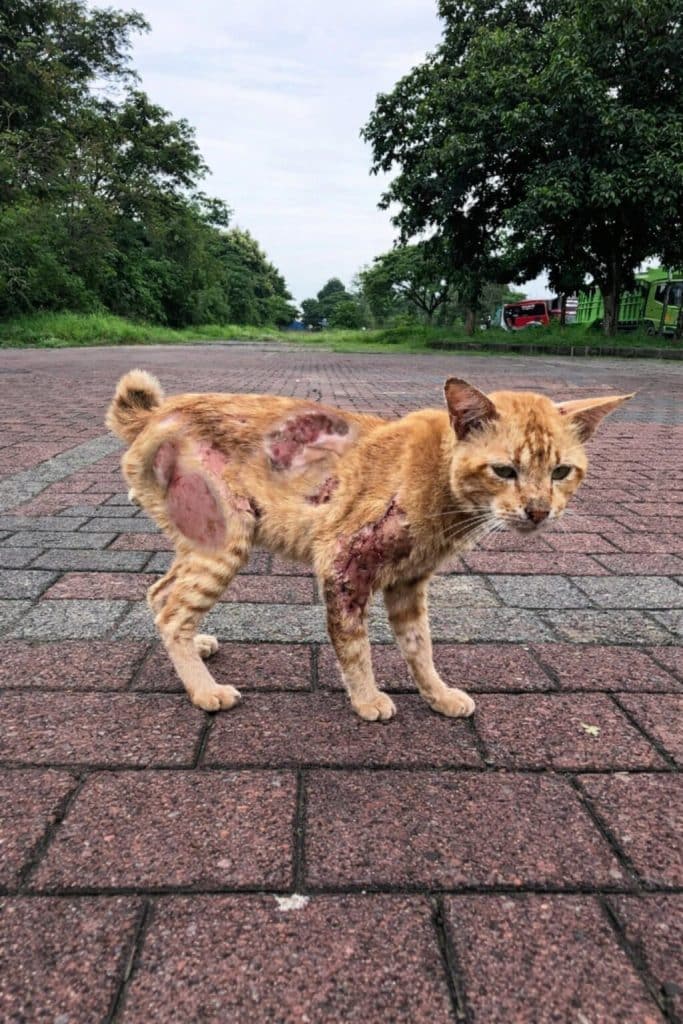
The golden tabby crouched low against a wall, pressing himself into the corner as though hoping to disappear. His once-soft coat was uneven and thin. In several places along his legs and hips, large patches of skin were raw and inflamed from a severe infection. The discomfort was visible in the way he moved — carefully, guarded, always tense.
But what lingered most was not his condition.
It was his fear.
Every step toward him made his body stiffen. Every outstretched hand caused him to recoil. His wide eyes carried the look of a cat who had learned that survival meant staying alert at all times.
Rescuers knew this would take patience.
After several slow, careful attempts — speaking softly, avoiding sudden movements — they managed to secure him and gently place him inside a carrier. Even then, he remained rigid, breathing fast, unsure of what would happen next.
He didn’t know he was on his way to safety.
VIDEO: He Couldn’t Bear a Gentle Touch — 15 Days Later, He Leaned Into Kindness
A Diagnosis That Explained Everything
At the veterinary clinic, the cause of his suffering became clear. He was battling a serious skin infection that had progressed without treatment. The inflammation made even the lightest touch painful.
He wasn’t being difficult.
He was hurting.
During the examination, he reacted defensively, growling and attempting to push away hands that came too close. The veterinary team understood that his behavior was rooted in discomfort, not aggression. The goal was simple: reduce the infection, ease the pain, and give his body a chance to recover.
Treatment would require daily care.
And consistency.
The Quiet Routine of Healing
The first days were the hardest.
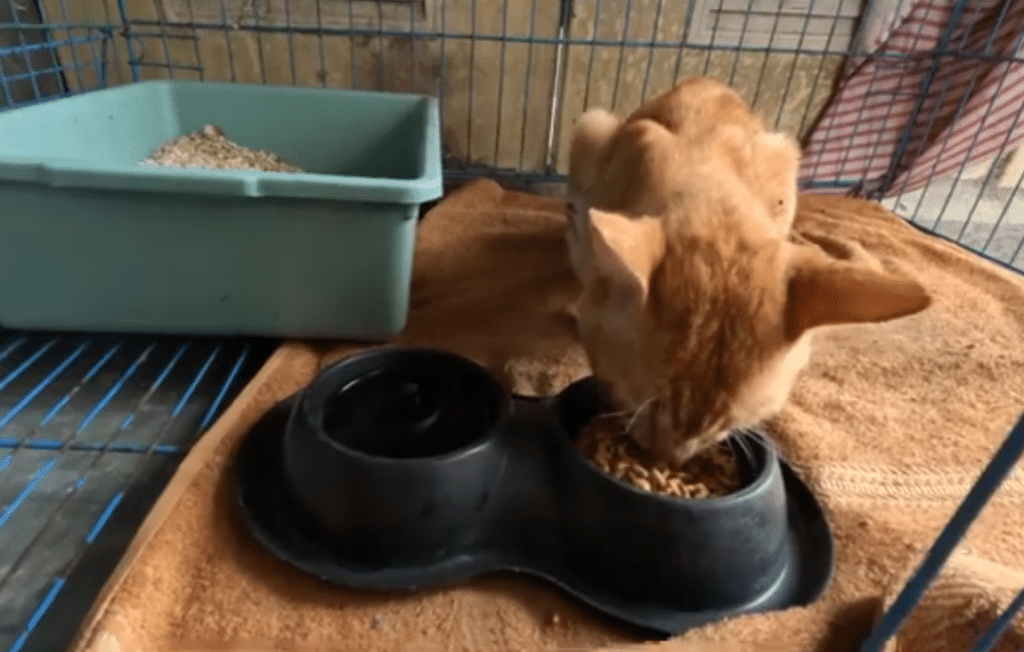
At home, the rescuer prepared carefully for each treatment session. Clean cloths. Prescribed medicated cream. Fresh bedding. Everything done calmly and without haste.
When the cream touched his affected skin, he reacted strongly. He would tense, hiss, and try to pull away. The sensation was uncomfortable, and his body was still sensitive from inflammation.
But the rescuer never rushed.
Each day followed the same rhythm.
Gently clean the areas.
Apply the medication carefully.
Offer nourishing food.
Give him space to rest.
Day after day.
The first visible improvement came around the tenth day. The redness began to fade. The open areas slowly formed new protective skin. The swelling reduced, and his posture softened slightly.
He started eating with more appetite.
He began moving around his space without constant hesitation.
Small signs of fur growth appeared where there had once been bare patches. His body, once thin and fragile, started filling out with proper nutrition.
But perhaps the most meaningful change wasn’t physical.
One afternoon, while the rescuer sat quietly nearby, he did not hiss.
He simply watched.
A few days later, he allowed a brief, gentle touch along his back. He flinched at first — a reflex he had carried for weeks — but he didn’t move away.
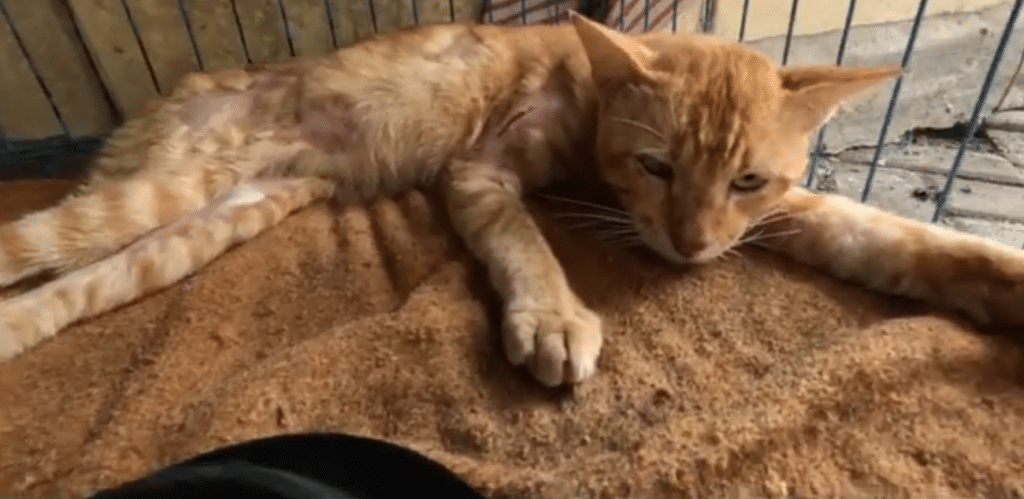
It was a turning point.
From Survival to Stability
By the end of two weeks, the infection was fully under control. Though a few faint scars remained, his skin had healed and his coat was returning to its natural golden shade. He no longer reacted to every movement with alarm.
He began eating comfortably near other cats.
He rested without constant tension.
He looked toward people instead of shrinking from them.
The cat who once couldn’t tolerate the lightest contact now accepted care with quiet trust.
What His Journey Teaches Us
Healing is rarely instant.
Trust is rarely automatic.
And fear often grows from pain we cannot immediately see.
This golden tabby did not transform overnight. His recovery was built on steady effort, gentle hands, and someone willing to return each day — even when the response was resistance.
Today, he stands healthy, alert, and calm. The fear that once controlled him has softened into cautious confidence.
His story is a reminder that compassion is not always dramatic.
Sometimes, it looks like patience.
And sometimes, patience is what turns fear into trust — one careful day at a time.