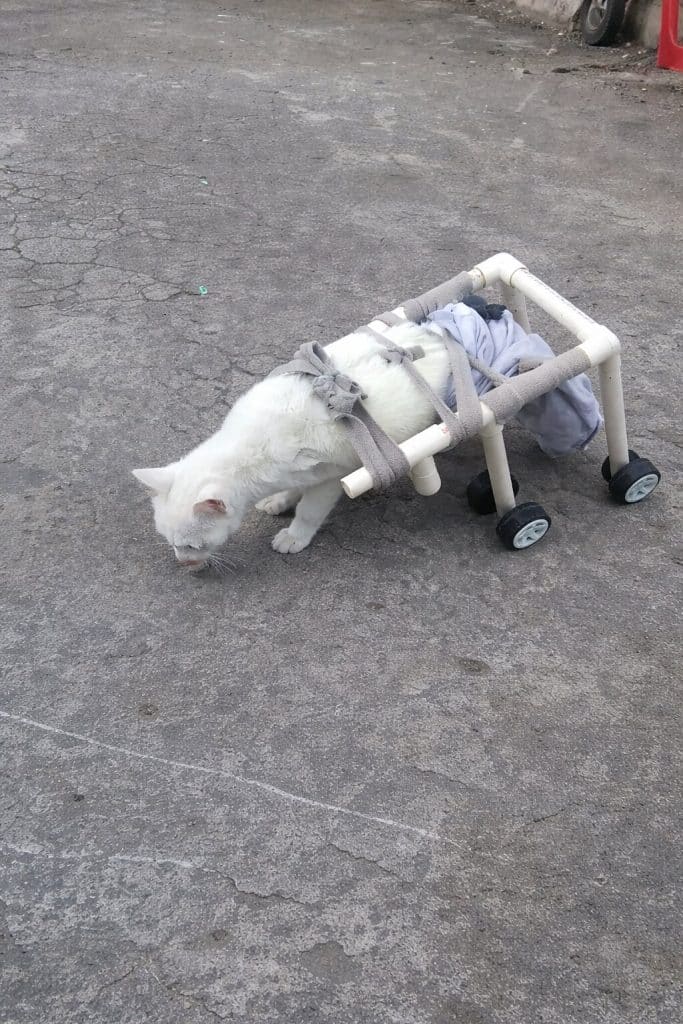
On a simple concrete yard, a white cat moved forward with quiet determination.
His back legs did not support him. Whether from paralysis or severe weakness, they no longer carried his weight the way they once might have.
But he was not lying still.
Attached to his body was a small, homemade wheelchair — carefully crafted from lightweight PVC pipes and soft fabric. It wasn’t fancy. It wasn’t store-bought.
It was built with intention.
Moving in a Different Way
Using his strong front legs, he pulled himself forward while the small frame supported his lower body. The wheels rolled smoothly across the concrete as he navigated the space with surprising coordination.
He paused briefly.
Lowered his head.
VIDEO: With a Homemade Wheelchair, He Crosses the Concrete Like Nothing Can Stop Him
Sniffed at something small on the ground — perhaps a crumb of food.
Then continued on.
Not rushed.
Not frustrated.
Just moving.
A Simple Device, A Big Difference
Mobility challenges in cats can result from spinal injury, nerve damage, or congenital conditions. While not every case is the same, supportive devices like custom carts can dramatically improve quality of life for some animals.
What makes this moment powerful isn’t just the wheelchair.
It’s what it represents.
Someone took the time to measure.
To design.
To assemble.
To adjust.
Someone refused to let immobility define him.
It’s not about perfection.
It’s about possibility.
Independence Looks Different for Everyone
He may not run the way other cats do.
But he explores.
He pauses to investigate scents.
He changes direction with ease.
He continues forward without hesitation.
There is no sign of self-pity.
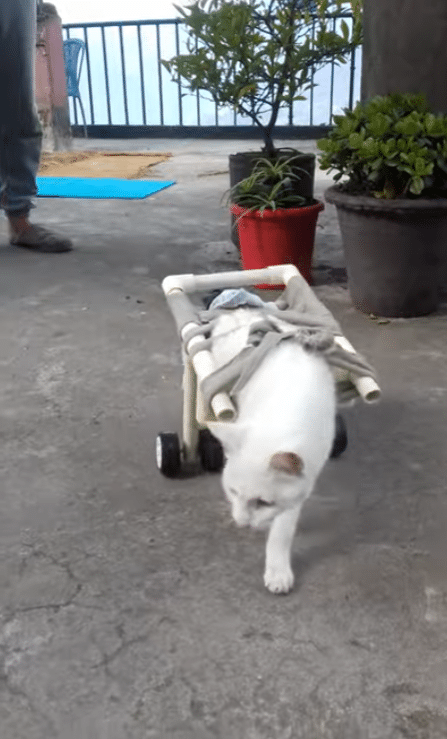
Only adaptation.
Love You Can See
The small PVC frame is more than a tool.
It is evidence of care.
Of patience during trial and error.
Of someone observing his needs and responding creatively.
Of the belief that he deserves movement, stimulation, and fresh air — just like any other cat.
Disability does not erase curiosity.
It does not erase joy.
It does not erase dignity.
And watching him roll steadily across the yard makes one thing clear:
Support doesn’t always mean carrying someone.
Sometimes, it means giving them wheels — and cheering as they move on their own.